
Will we see oil reach $100 in the near future?
Will we see Oil reach $100 in the near future?
The last two years have been very turbulent for oil. The pandemic and price wars combined together to crash oil futures into the negative price zone briefly in 2020. Followed by an increased focus on the net zero emissions pathway to reduce fossil fuel consumption.

Let us take a detailed look at the price mechanism of oil for a better understanding about the future of oil as a commodity.
Current Price Cycle
According to the IMF, oil is going through a price super cycle that started sometime after 2014. In a super cycle, the prices overshoot their long-term average levels. The current super trend was kickstarted by the rapid economic growth of China, which led to globally increased levels of demand for oil.
This increase in demand was met by supply-side shortages. One major factor driving the supply side shortage is the transition of oil-producing gulf economies from oil-based rentier economies to service-based economies. Oil producers like Saudi Arabia, UAE, Qatar, and Kuwait have assessed that their oil reserves will not sustain their economies indefinitely. As a result, these economies have shifted the focus from investment in oil exploration into the services sector of their economies.
The reduced oil investment will affect oil supply and price in the long run but there is little threat to the short-term trend. According to the IMF, in spite of the global push towards net-zero emissions, demand for oil in the developing countries will rise. Particularly economies like India and China will keep an upward pressure on global oil prices as their middle-class upward mobility increases, leading to increased demand for personal cars and air travel.
Why are oil prices rising?
Ideally, the prices should have stabilized to pre-pandemic levels around the $60 mark. But the graph below shows us that the prices have risen up to $80 per barrel. What caused the prices to keep rising as economies reopened?
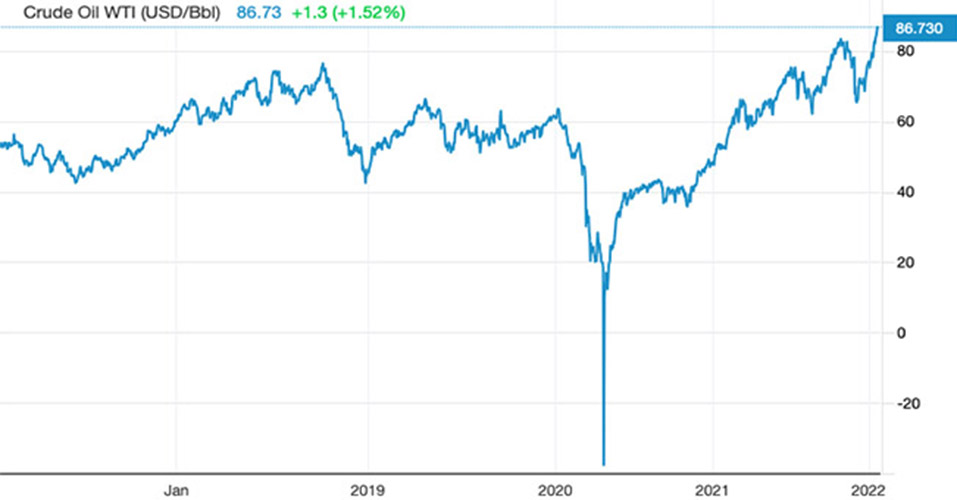
Source: Trading Economies
Firstly, as the economies reopened, a lot of pent up demand overwhelmed the oil producers. Causing the price to rise sharply. At the same time, the net zero emission pledge, caused suppliers of coal and gas to restrain the mining operations, leading to increased prices of coal and gas.

This had a knock-on effect on economies like India and China that use coal and gas to power up their electricity generation. As coal and gas became unfeasible for these economies, they decided to shift to oil to stabilize their power generation. This increased the oil demand, leading to added upward pressure on price.
Then came the winter of 2020 and energy demand shot up across Europe, leading to a further rise in demand and price of oil. At the same time, another crisis was brewing across the oil supply chain. The pandemic caused truck driver training schools to remain closed, this delayed the new batches of truck drivers leading to a shortage of truck drivers as economies reopened. This acute shortage of truck drivers has increased the time that it takes for oil stocks to replenish.
Presently, oil inventories are already below average across Asia and Europe. Supply chains have not yet come back to pre-pandemic functionality and oil producers are reluctant to increase supply. All of these factors have combined together to push the prices up.
What is the future of oil?

It is important to understand that there is no immediate threat to oil. The push for net-zero emissions requires significant investment, research, development, and deployment of sustainable energy solutions. The problem with this is that a lot of sustainable solutions are in their early stages of research and development.
Green hydrogen, for instance, is in the early stages of R&D. Australia, which is one of the leading countries looking to create a competitive advantage in green hydrogen, is still trying to create suitable infrastructure and supply chain networks for green hydrogen. Then there will be a need to set up manufacturing plants, storage, and delivery mechanisms.
Until the production of green hydrogen is scaled up and supply chains established at a global level, oil has no immediate threat from green hydrogen. The world will still need oil to power industries. As long as there is demand for oil, there is going to be supply.
Investor Takeaway
The conclusion that we can draw from this discussion is that oil still has a future. There is too much demand for oil to be replaced by sustainable sources in a short span of time. At the micro-level, it is slightly difficult to assess where the price of oil is expected to be. The short-term price of oil is going to be impacted by the following factors.
• Oil Supply: If oil producers such as OPEC and USA decide to increase the supply of oil, the upward pressure can be reduced to keep the price between $75 to $85. At present, there is no indication that the oil producers intend to increase oil supply.

• Nord Stream: Germany has suspended the certification of the Nordsteam 2 pipeline. This is going to put upward pressure on gas and coal prices, as winter approaches. As the price of oil and coal goes up, the oil demand will rise as well. With this factor in mind, we can assume that prices may hover around $85.
• Winter Severity: According to the Bank of America, global oil prices can push up and cross the $100 per barrel mark if the Northern hemisphere sees a harsh winter.
Keeping these factors in mind and given that all else remains constant, we can estimate that global oil prices are likely to push up to $100.