
Will gold prices reach $2,700 this year?
Will Gold Prices Reach $2,700 this Year?

In an era where financial instability seems to lurk around every corner, gold continues to captivate the attention of investors worldwide. As of May 2024, gold prices have touched the $2,400 per ounce mark, reaching record highs not seen before. The yellow metal's meteoric rise—driven by a complex interplay of inflation fears, geopolitical tensions, and robust physical demand from central banks—has left many pondering what could be the next milestone.
Gold Price Movements
Before we can look at the future projections, it is important to look back at the historical performance of gold.
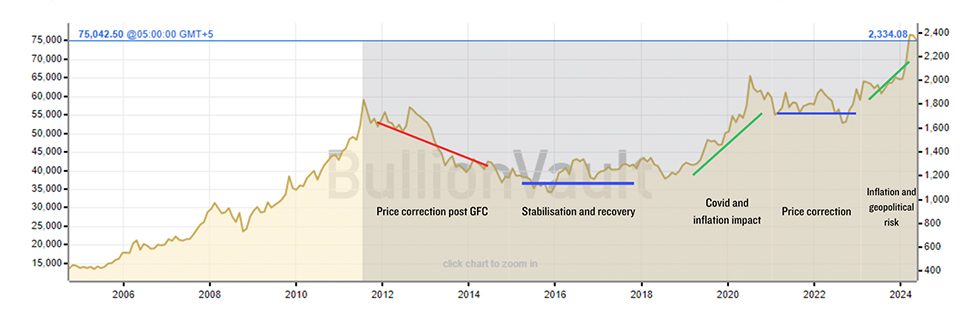
Gold prices have seen notable fluctuations over the past decade, influenced by various economic, geopolitical, and market factors.
2013-2014: Post-Crisis Adjustments
After peaking in 2011, gold prices declined as the global economy started recovering from the 2008 financial crisis. The Federal Reserve's tapering of quantitative easing reduced demand for gold, causing prices to fall from around $1,600 per ounce in 2013 to about $1,200 by the end of 2014.
2015-2018: Stabilization and Gradual Recovery
During this period, gold prices stabilized with periodic fluctuations. Strong USD and expectations of rising interest rates were the key drivers for this stability. However, geopolitical events like Brexit and the US-China trade war created economic uncertainties that supported gold prices, leading to a recovery to about $1,280 per ounce by the end of 2018.
2019-2020: Surge Amidst Global Uncertainty
Gold prices surged in 2020 due to heightened geopolitical tensions, economic uncertainty, and the COVID-19 pandemic. The pandemic, in particular, drove investors towards gold as a safe-haven asset, pushing prices to a record high of over $2,070 per ounce in August 2020.
2021-2022: Corrections and Consolidation
Following the 2020 peak, gold prices corrected as the economies reopened. Rising bond yields and a stronger US dollar kept gold prices under pressure, which stabilized around $1,800 per ounce by the end of 2022 amid ongoing inflation concerns.
2023-Present: Renewed Bullish Trends
In early 2024, gold prices surged past $2,400 per ounce due to persistent inflation, heightened geopolitical tensions, and increased central bank demand, particularly from China. These factors have reinforced gold's status as a safe-haven asset.
Top Gold-Buying Countries
The demand for gold is not just a phenomenon in investor circles but also among nations and in the last few years we have seen a trend where countries have strategically invested in gold to boost up their reserves.
The following countries were the largest buyers of gold in 2023: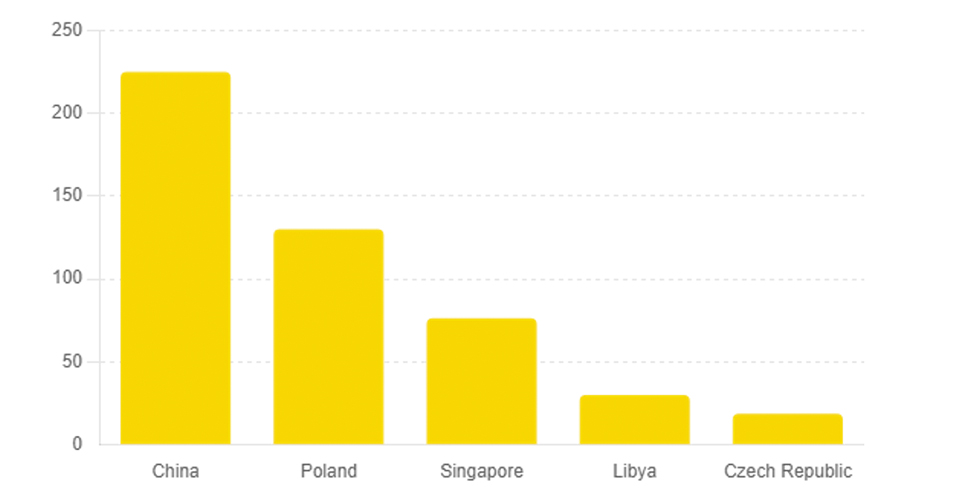

1. China (224.88 metric tons): China was the largest buyer of gold in 2023. The People's Bank of China bought gold in all quarters of 2023. At present China`s gold reserves represent 4.33% of its foreign reserves (DW).
2. Poland (130.03 metric tons): Poland was behind China in buying gold in 2023. Poland's gold buying spree made it have the 15th largest gold reserves in the world.
3. Singapore (76.28 metric tons): Singapore was the third-largest net buyer of gold in 2023, ending the year with the 23rd largest gold reserves globally.
4. Libya (30.01 metric tons): Libya holds fourth largest gold reserves in the Middle East & North Africa. Libya bought almost 30 metric tonnes of gold in the last quarter of 2023.
5. Czech Republic (18.71 metric tons): The Czech Republic bought all its gold in the fourth quarter of 2023, representing a 156% increase in its gold reserves.
To make sense of why these countries are investing significant sums into gold, let`s have a look at the current demand drivers for gold.
Key Drivers of Current Demand for Gold
The demand for gold is driven mainly by the geopolitical risk and inflation. Let`s have a deeper dive into these demand drivers.

Interest Rates and Economic Policy: The interplay between interest rates and gold prices continues to be a significant factor. While high interest rates generally reduce the appeal of gold, high inflation coupled with the expectation of potential rate cuts later in the year could further boost gold's attractiveness. Analysts predict that policy rate easing may support gold prices, despite the complex relationship between inflation, interest rates, and gold.
Safe-Haven Asset: Gold continues to be viewed as a safe-haven asset, particularly in times of economic uncertainty and geopolitical tensions. Recent military conflicts, such as those in the Middle East, have significantly boosted demand for gold as investors seek stability in volatile times.
Diverse Demand: The demand for gold is not homogeneous across regions. Western investors have shown robust buying but also profit-taking, while Eastern markets, especially in China, have seen strong buying into price surges. This regional difference underscores the complex global dynamics driving gold demand.
Over-the-Counter (OTC) and ETFs: OTC investments have played a significant role in the rising demand for gold. While gold ETFs saw outflows, indicating some profit-taking by institutional investors, the demand for physical gold and coins remains strong, particularly among retail investors. This trend is highlighted by significant purchases in markets like China, where retail buying surged by 68% year-on-year in the first quarter of 2024.
Central Bank Purchases: Central banks have also been major players in the gold market, increasing their reserves to diversify away from the US dollar and bolster economic security. Central banks' purchases accounted for 23% of total gold demand in the first quarter of 2024, a significant increase from historical averages.
Market Sentiment: Speculative buying has also been a driver of gold prices. The fear of missing out (FOMO) effect among retail investors has contributed to the continued rise in gold prices, despite some profit-taking by larger institutional players.
Predictions from Financial Experts and Analysts

Goldman Sachs has revised its forecast and alerted their clients, predicting gold prices to reach $2,700 per ounce by the end of 2024. This bullish outlook is driven by strong demand from central banks, persistent geopolitical tensions, and a favorable macroeconomic environment that boosts gold's appeal as a safe-haven asset.
Goldman Sachs has revised its forecast and alerted their clients, predicting gold prices to reach $2,700 per ounce by the end of 2024. This bullish outlook is driven by strong demand from central banks, persistent geopolitical tensions, and a favorable macroeconomic environment that boosts gold's appeal as a safe-haven asset.
Citibank analysts, on the other hand are even more optimistic, forecasting that gold prices could climb to $3,000 per ounce within the next 6 to 18 months. This prediction is based on robust physical demand from central banks and investors seeking a hedge against economic uncertainties and inflation.
Market Pulse Analysis shows varied but generally positive predictions for gold prices, with some forecasters expecting significant growth. Projections suggest that gold could climb beyond $3,000 by mid-decade, influenced by ongoing economic uncertainty, inflationary pressures, and geopolitical risks.
Investor Takeaway
For investors looking to safeguard their portfolios and capitalize on market trends, gold offers a compelling opportunity. The current economic environment, characterized by inflation, geopolitical tensions, and financial market volatility, underscores the importance of including gold in one's investment strategy. With expert predictions suggesting a rise to $2,700 or even higher, now is an opportune time to consider investing in gold.
Investors should heed the signals from historical trends, expert forecasts, and the current economic landscape, positioning themselves to benefit from gold's potential ascent to $2,700 this year, with the possibility of even greater gains on the horizon.