
What is happening with the gold price?
What is happening with the gold price?
Gold is a multi faceted asset. It is a good risk stabilizer, highly sought as jewellery in India, China, United States and other countries, a reserve asset for Central banks and also a key component in many electronic products due to its excellent conductivity.
All of these factors combine together to make the demand for gold. With its supply being limited and demand increasing steadily over time, the prices of gold have always followed an upward trend at a CAGR of 14%. This makes gold an ideal asset for long term investment.
Gold Price Movements
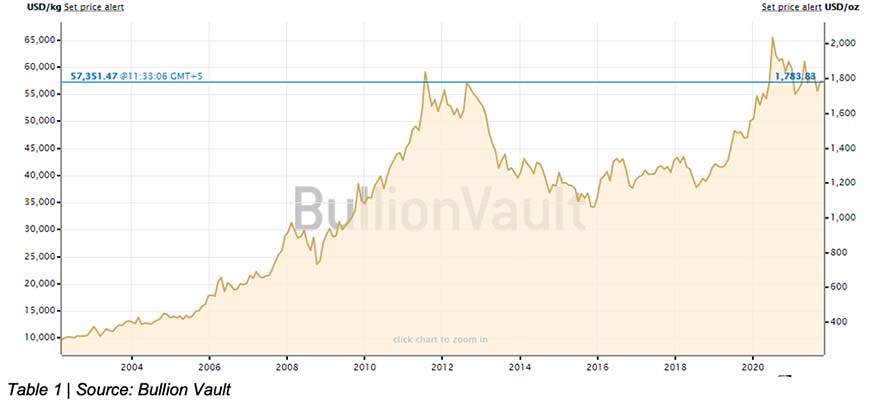
This twenty year price chart for gold, shows how the prices of gold have moved in the last two decades. Leading up to the 2008 global financial crisis, gold prices saw a sharp increase and the prices peaked around 2012. Followed by roughly four years of bearish prices which then turned into a bullish pattern around 2019 to touch a new peak during the 2020 financial crisis. Following the 2020 financial crisis, gold prices have again gone into a bearish pattern.
We can also see that although the price of gold fluctuated in the short term but long term price movement has been positive and the price of gold has gone up by over 500% in the last twenty years and over 5000% since 1970, whereas the Dow Jones index has only gone up by 4080% in the same time.
Gold - Dollar relationship
The gold - dollar value comparison is a popular way to determine the trend of gold prices at any given time.
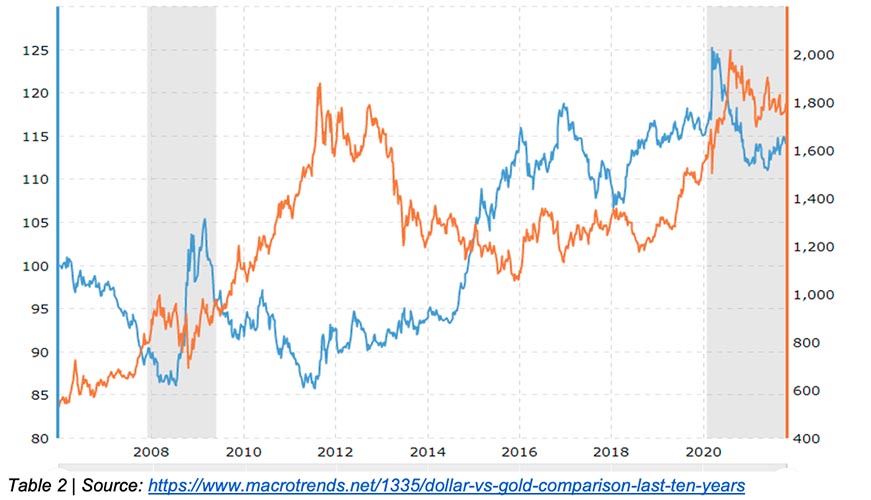
The chart above shows the values of gold and the USD plotted against each other, with gold represented in orange and the USD in blue. It can be seen that both gold and the USD have an inverse relationship. Whenever the value of gold goes down, the value of the USD goes up and vice versa.
This relationship is based on the investment decisions made by investors. Gold is perceived as a stable asset, which means that when other assets such as stocks, bonds and USD are bullish, investors tend to put their money in these bullish assets instead of gold for greater return.

When these assets enter a bearish pattern, as seen by the graph shown above. Investors shift their funds to more stable assets like gold to protect their investments. This shift increases the demand for gold which results in an increase in price.
Gold is also seen as a hedge against inflation. High levels of inflation in most countries are going to push investors to invest more into gold to protect their savings and hedge against current high levels of inflation.
However, there is a valid reason for concern in the market. The value of gold has dropped from a high of $2000 per ounce to around $1800 per ounce in the last year, translating to a value loss of almost 14% in a single year. This is significant for investors, who are worried about the future of gold.
What is causing the price drop?

The recent price drop was triggered by panic selling by the sellers as FED announced the economic projections for the next two years. The projections indicate multiple policy rate increments.
The value of gold does not have any correlation with the policy rate, as it has with the rate of USD. Generally, it is understood that when interest rates rise, investors shift their focus to high interest bearing assets and this causes the value of gold to drop. However before the 2008 financial crisis, the value of gold was rising together with rising policy rates. Similarly, the period between 2012 and 2020 saw very low interest rates and the value of gold also remained in a bearish pattern for almost six of these eight years.
According to George Milling-Stanley, chief gold strategist at State Street Global Advisors. The projections by FED are nothing to be afraid of. Speaking to Kitco, Milling-Stanely said that,
“I am looking at the gold market right now and I think this could prove to be a good time to buy. I see a lot of panic selling and I don t think that can last much longer. Basically, the markets saw higher inflation and higher interest rates, but they completely ignored the fact that the hikes are at least two years away. A lot can happen in two years.”
Milling-Stanley also believes that once the panic buying ends, the gold prices can rise up to $1900 or even $2000 by the year end. In his opinion, FED estimates are based on inflation projections, which may not materialize the way they are being seen. Additionally, even if inflation rises, it will not be easy for the FED to raise interest rates, as doing so would create a budgetary deficit for the government, close to the elections.
In light of all this, it can be said with relative certainty that the current bearish trend in gold value is transitory at best. Gold has always been a profitable investment for long term investors and will continue to be so. The current bearish trend has been caused by a mixture of low consumer demand due to the pandemic and increased focus of investors into the equity markets as they rebounded after the pandemic. As the markets normalize, gold is expected to return to its traditional stability.