
What is green hydrogen?
What is Green Hydrogen?
The climate crisis has triggered a global transformation in the way we do business. The demand for climate-positive and sustainable solutions is rising as fast as the severity of the crisis.

The Paris Agreement set the tone for a global shift to curb carbon emissions and transition towards clean and green sources of energy. The most recent COP 26 conference has further strengthened this resolve to achieve net zero emissions by 2050.
Achieving the net zero emissions target requires disruptive strategies to shift the global demand for energy from fossil fuels to more sustainable forms of energy. The primary driver of this transformation is going to be the flow of investment. In the past and present as well, the flow of investment in the energy sector has been largely into fossil fuels but this trend is changing gradually towards alternative investment in sustainable energy.
The investment flow into the sustainable energy sector is increasing with both public and private sectors taking the initiative to develop this nascent industry. Increased investment into this sector is necessary to develop infrastructure, create supply chains and scale up the technology to create previously unknown opportunities.
While renewables such as solar and wind power have been the focus, hydrogen has emerged as a strong contender to replace the bulk of our energy requirements. Investing in hydrogen can potentially solve the problem of providing sustainable energy to industries but is hydrogen sustainable?
Green Hydrogen Explained
Hydrogen is the most abundant element in the universe and it can be easily extracted from different sources. The source used to extract hydrogen, determines whether hydrogen is sustainable or not.
Blue hydrogen requires natural gas as its source fuel. It is produced when natural gas is split in hydrogen and carbon dioxide. The carbon dioxide produced can be captured to prevent emissions into the atmosphere, leaving blue hydrogen to be used for industrial and commercial purposes. However, the production of carbon dioxide and the costs attached to capture and store it makes blue hydrogen unsustainable in the long run.
Yellow hydrogen is manufactured only through solar power as the main source of energy and pink hydrogen is manufactured through nuclear power. While blue hydrogen is not exactly clean, yellow and pink hydrogen are not that feasible for industrial production.
Green hydrogen on the other hand requires water as its source fuel. It is produced through the electrolysis of water. The energy for processing green hydrogen comes from renewable sources such as solar or wind energy. The process creates green hydrogen, which is stored for industrial and commercial purposes and oxygen which is released into the atmosphere.
From start to end, green hydrogen is completely clean and sustainable. This makes green hydrogen the leading contender to replace fossil fuels. However, some industry experts are of the opinion that the transition from fossil fuels to green hydrogen will not happen directly. There is likely to be a transition to blue hydrogen first and then to green hydrogen.
Hydrogen Potential of Australia
Australia is one of the biggest exporters of fossil fuels. It has a competitive advantage over other countries over the export of coal and gas. The Australian policy makers understand that this competitive advantage will not last for long, which is why the government came up with a long term emission reduction plan to shift the competitive advantage from fossil fuels to hydrogen.
According to the long term emission reduction plan, Australia aims to produce hydrogen at less than $2 per kg to achieve a competitive advantage. At present, green hydrogen can be produced at rates between $6 and $9 per kg. In order to reduce this rate, Australia needs to invest in the hydrogen industry and create a local ecosystem.

Australia aims to become a leading exporter of green hydrogen in the Indo-Pacific region, in the coming decades. The country is well positioned to take advantage of the abundance of opportunities present in the green hydrogen sector.
According to a statement by the Australian premier Scott Morrison, Australia intends to develop the hydrogen industry by focusing on developing technology instead of taxation. The Australian government plans to invest $1.2 billion by 2030 for the development of the hydrogen industry.
If the government follows through with its plans, then by 2050, the hydrogen industry in Australia can be worth at least $26 billion. This will create almost 395,000 jobs in the next two decades. This feat cannot be achieved by the government alone, which is why the government is trying to facilitate the private sector to take initiative and bring in investment.
Hydrogen Investments in Australia
Australia is collaborating with other countries to develop infrastructure and create supply chains for green hydrogen production and transportation. At least seven clean hydrogen industrial hubs are to be established in Australia. The aim of these hubs is to create an ecosystem, which can then be scaled up.
At the present, there is no large-scale facility in Australia for this purpose. There are around 70 pilot projects operational in various parts of Australia. These projects can be scaled up, depending on the performance and efficiency during the pilot phase.
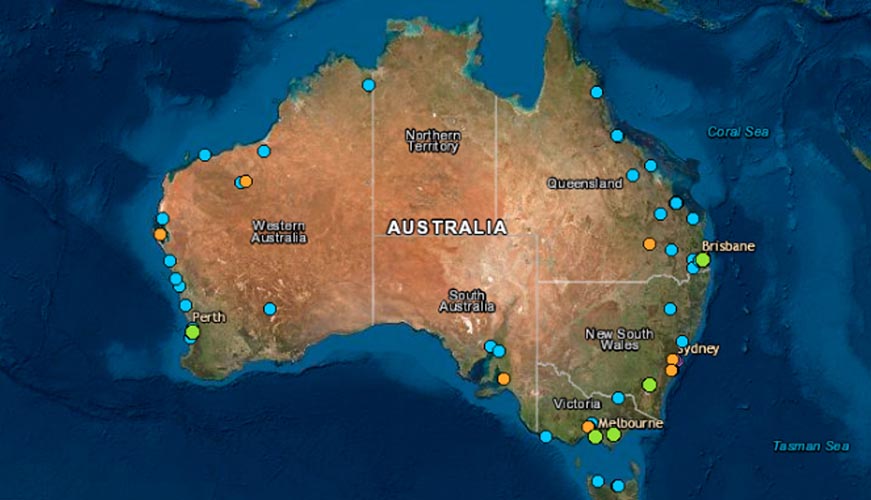
Source: https://portal.ga.gov.au/persona/hydrogen
The map above shows the locations of operational and underdevelopment projects for green hydrogen in Australia.
Fortescue Future Industries is one of the biggest private sector companies that is planning to invest over $2.6 billion to build hydrogen manufacturing plants and hydrogen fueled power plants in Queensland and New South Wales regions.
Andrew Forrest, the owner of Fortescue Future Industries, is of the opinion that in the future there is going to be no bigger industry than hydrogen, it would even dwarf the coal and iron ore industries.
Arena is another company that is investing heavily in the nascent hydrogen industry. Arena has invested almost $55 million into 28 different hydrogen projects. According to Darren Miller, the CEO of Arena, they have identified hydrogen as a future export opportunity.
“Hydrogen sits centrally in the energy transition, and it’s really important that we recognise its potential and scale and grow its potential together.” Darren Miller, CEO of Arena.
According to BP, Western Australia is an ideal place for the large-scale production of green hydrogen. There are abundant natural resources such as solar and wind energy to power up green hydrogen producing plants. Furthermore, Western Australia already has an existing infrastructure that can support green hydrogen production and upscaling.
Investor Takeaway
The nascent hydrogen industry is following in the footsteps of the fossil fuel industry when it was young. Back then industrialists and investors understood that huge investments were required to create economies of scale and cost reductions. This led to the mammoth expansion of the fossil fuel industry.
The hydrogen industry has the same projection. It requires huge investments, which are starting to pour in as focus increases on climate change and sustainability. It is expected that as investment into this sector increases, cost reductions will make future investments exponentially profitable for the early investors. This means that for the coming decades, the hydrogen industry in Australia is going to be one to watch out for.