
Is US property a good investment?
Is US Property a Good Investment?

Creating a well diversified portfolio requires knowledge of the investment options available in the market. While equity and bond investments are the most well known asset classes, there are a lot of other asset classes such as precious metals and real estate.
Real estate or property investment is a highly regarded asset class, particularly by the high net worth individuals. The reason why it is so popular with high net worth individuals is because the property investment has the potential to generate year round results. Investing in a rental property can create a constant cash flow stream and it eventually leads to capital appreciation.
In addition to this, property investment does not tie up a lot of cash. You can get into a mortgage to purchase any property with a 10% down payment of the total value. Compare this with purchasing equity or bonds, where you have to pay for the whole value of the asset right away.

Moreover, there are many ways through which individuals can invest in property. You do not necessarily have to buy a property to own it. You can invest in house flipping by purchasing undervalued properties and then selling them for a profit. There is also the alternative investment option of REITs or real estate bonds, which can help you reap the benefits of property investment without the regular drawbacks.
Property investment is therefore a very profitable asset class, with its own unique market fundamentals that need to be understood before investing into it.
Real Estate Sector in the US
The real estate sector in the US is among the most profitable sectors of the economy. From 1982 to 2020, housing prices in the US have increased by an astounding 416%. This means that $100,000 invested into a property four decades ago, would have grown by over $416,000 today.
Long term trend aside, even the short term annual price growth is quite lucrative for investors. From 2020 to 2021, housing prices in the United States have increased by 16.2%. This means that investment of $100,000 into any property last year, would have seen appreciation by almost $16000 today.

The 16.2% figure is an average. We can get a better idea by looking at outliers in the data. Cleveland for instance has a very high real estate market, with an annual property price increase at 25.7%. Whereas, Ohio saw a very conservative 8.8% increase in the sale price of real estate in a single year.
Is this price trend likely to last long? Let’s take a look.
Price Trend in the Real Estate Industry
To get a better understanding about how prices in the real estate sector tend to rise over time. Let us look at the all time median housing price chart.
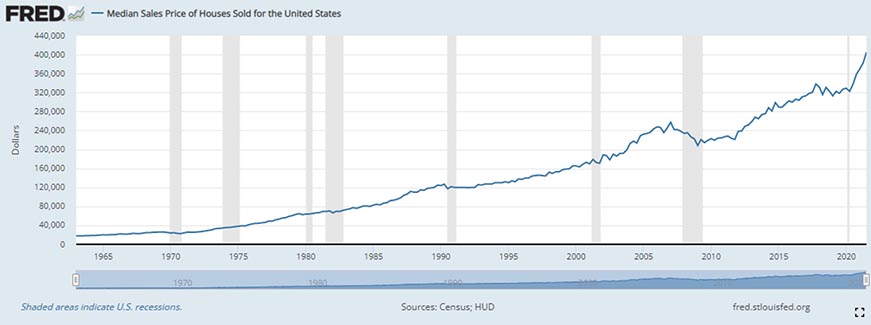
The median sales price graph above, clearly shows how the housing price in the United States has always followed an upward trend. If we zoom into the last five years of this graph then we can identify a very significant trend.
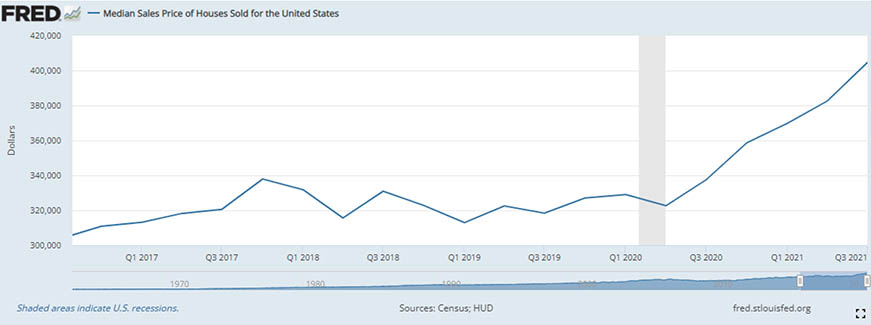
The housing prices were showing signs of stabilization or in other words stagnation in the market prior to 2020. The first quarter of 2020, marks the Covid-19 induced economic recession that gripped the global economy. The trend in the housing prices from the second quarter of 2020 shows a steep rise in median housing prices.
Both of the graphs shown above, clearly indicate that this is the steepest rise in real estate prices in history. How could the recession trigger such a steep price rise in the real estate market?
To find the answer, we must understand that even prior to the pandemic, the market was doing very well. There was a steady demand for new homes that was being met by a steady supply of housing. However, the pandemic proved to be a disruptive factor for the market.
Frank Nothaft, the chief economist at CoreLogic says that, “We’ve been tracking housing prices for over 20 years, and we’ve never seen anything like this.”
The pandemic changed conditions that were assumed to be constant. For instance the work from home phenomenon made many people realize that they could shift to full time work from home. As individuals and couples adopted full time work from home routines, the demand for housing grew.
People also realized that they no longer needed to reside near their places of work. As a result the demand for housing in suburbs and areas further from city centres grew. This was complemented by the fact that mortgage rates dropped very low at the peak of the pandemic. This provided a window of opportunity for many individuals and families to buy their own home, leading to a spike in demand in spite of the pandemic.
Similar trends were seen in the industrial and commercial real estate markets. As businesses shifted online and digital business activity increased, the demand for industrial real estate increased. This demand was mainly being driven by the e-commerce and fintech sectors.
Apart from the pandemic, the push for net zero emissions and more sustainable business models also created an upward price push, particularly in the commercial and residential real estate markets.
All of these factors combined together to create one of the steepest price increases in the history of the real estate market of the US. This price increase of the real estate sector may be good news for investors looking to sell their properties but there is another side of this industry that we need to analyse.
Rising Rents
The three or four quarters that fell in the midst of the pandemic saw reduced rents. However as economies reopen and go back to pre pandemic levels, it is being observed that housing rent is spiking in a manner similar to real estate prices.
According to CNBC, in some places rents have gone up by almost 40%. Wiping out any gain that the tenants received through relaxation in rent during the peak of the pandemic. There has been an uptick in the demand for housing. Not everyone can pay the 10% down payment to get into a mortgage to buy their house. Furthermore, the mortgage rates have started going up as FED has indicated to increase the policy rates.
This means that there is going to be increased demand for rental properties and this is going to drive rent up.
Investor Takeaway
To conclude this discussion, in light of the aforementioned it can be safely assumed that the real estate market in the United States is going through a boom phase. The uptick in demand complimented by limited supply is going to drive both real estate prices and rent upwards. As the economy reopens and unemployment numbers fall, the increased demand will fuel this rise in prices.
These conditions make it an ideal time to invest in real estate bonds to diversify your portfolio, stabilize the risk and establish a passive income stream.