
Is helium the commodity you should watch?
Is Helium the Commodity You Should Watch?

In the world of critical commodities, helium is rapidly emerging as one of the most vital yet underappreciated resources. With global supply chains facing unprecedented disruptions, helium’s role in industries like healthcare, semiconductors, and space exploration is more critical than ever. As the market is projected to reach $6.07 billion by 2030, and with supply shortages driving up prices, now is the time for investors to take a closer look at the opportunities within the helium market.
But why exactly is helium indispensable—and why should it be on your radar? The answer is clear: helium’s unique properties make it essential for cutting-edge technologies, positioning it as a prime commodity for future growth.
Market Structure and Investment Opportunities
The helium market operates under an oligopolistic structure, meaning that a small number of major players control the majority of global helium production and supply. Leading companies like Air Products and Chemicals, Linde Plc, and Air Liquide hold dominant positions, benefiting from their ability to access vast helium reserves and their established infrastructure for extraction and liquefaction.

This market dominance creates high barriers to entry, making it challenging for smaller players to compete. The process of extracting helium from natural gas is both capital-intensive and technologically complex. Furthermore, helium is not traded like other commodities (such as oil or gold) on open markets. Instead, it is traded through long-term contracts, which can offer investors a degree of stability not found in other commodities.
For potential investors, the helium market presents a lucrative opportunity. As supply shortages continue, prices are expected to rise, and companies securing these long-term contracts stand to profit significantly. Investment in helium production is especially attractive in regions like Canada, where new extraction sites are being developed.
The complexity of the market may deter some investors, but for those willing to navigate the opaque trading system, there is potential for high returns. Companies involved in helium recycling—which involves collecting, purifying, and reusing helium—are also expanding, driven by the increasing focus on sustainability and resource efficiency.
Key Sectors Driving Future Demand
Helium’s exceptional properties make it indispensable across various industries.
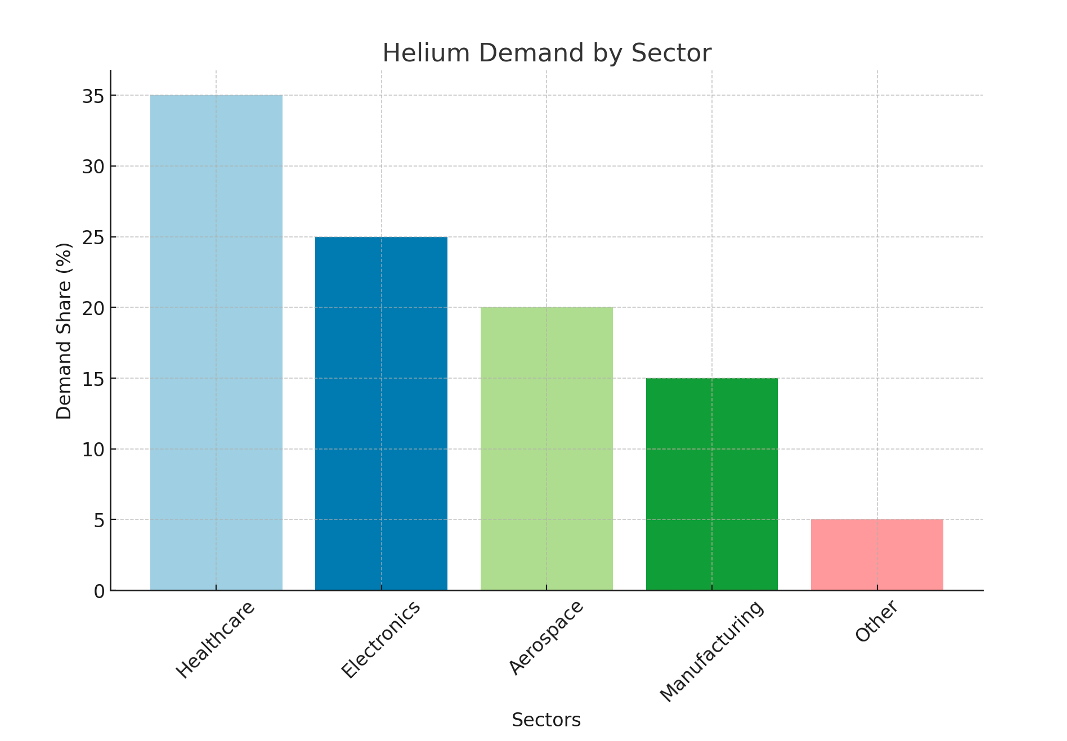
The Healthcare industry accounts for almost 35% of helium market revenue and uses helium in critical medical imaging devices like MRI machines, ensuring precise and non-invasive diagnostics. As global healthcare expands, the demand for MRI machines—and consequently helium—is set to grow at a steady rate of 4.3% from 2024 to 2031.
Although currently, the electronics sector is second in terms of global demand for helium, the semiconductor industry is growing so fast that it is likely to overtake the healthcare sector in terms of demand. Semiconductor manufacturers rely heavily on helium for processes such as ion beam milling and chemical vapour deposition, which require stable, low-temperature environments.
According to research by IDTechEx, the demand for helium is expected to double by 2035, driven mainly by the demand for semiconductors. This trend is particularly strong in the Asia-Pacific region, where nations like China and South Korea dominate the semiconductor market.
Aerospace is another major driver of helium demand. The gas is indispensable for space exploration missions, used to pressurize fuel tanks, cool sensitive instruments, and maintain stable temperatures in spacecraft. With the rise of private space companies like SpaceX and the ongoing developments in space tourism, the need for helium will only increase.
The global helium market, valued at $4.81 billion in 2023, is set to grow steadily over the next decade with a 6.7% CAGR. This growth is fueled by several factors that include rapid advancements in electronics, medical diagnostics, and increasing demand from space exploration.
Geopolitical and Supply Constraints
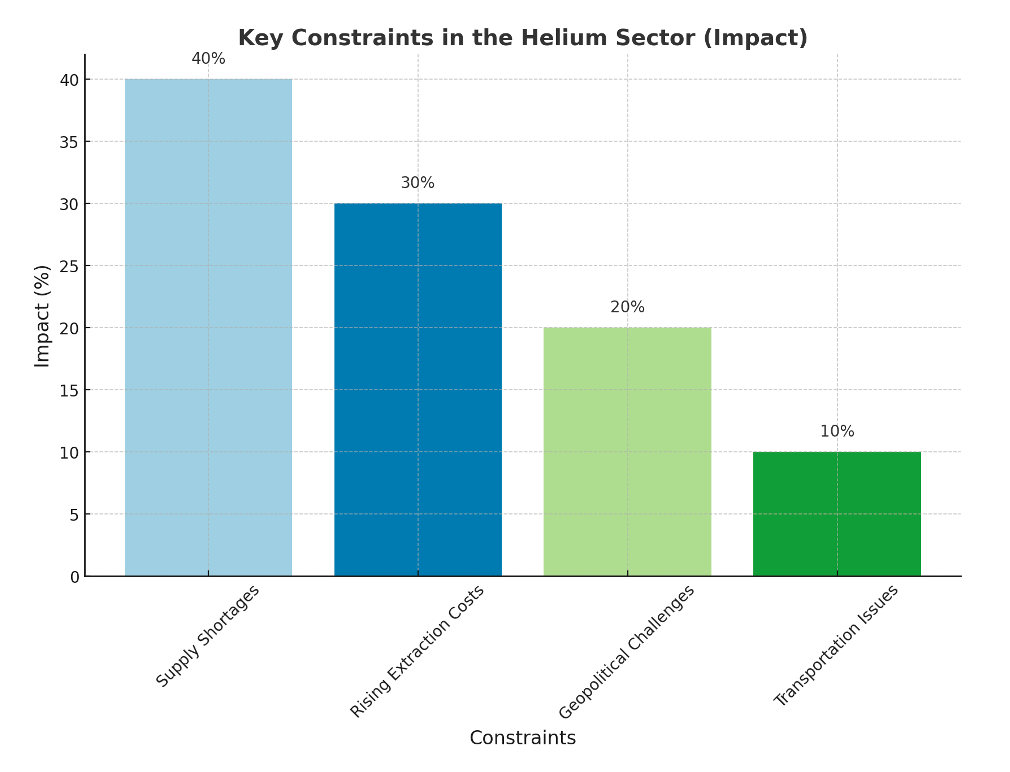
Despite its growing demand, the helium market faces significant supply challenges, largely driven by geopolitical factors. The depletion of the U.S. Federal Helium Reserve and export disruptions from Russia (which controls almost 25% of global helium reserves) due to geopolitical tensions and sanctions, have exacerbated global supply shortages. These constraints, however, present unique opportunities for savvy investors.
With supply tightening and prices rising, securing long-term contracts with major helium suppliers could yield stable, high returns in the coming years. These contracts provide a buffer against price volatility and supply disruptions, offering a predictable revenue stream even during periods of market instability.
Additionally, the emergence of new helium production sites outside of traditional regions, such as Canada and Qatar, creates further investment opportunities. Companies developing these new reserves stand to benefit from favourable market conditions, as demand continues to outpace supply. For example, North America Helium’s recent expansion into Canada is a key development that positions it as a growing player in the market, offering investors the chance to capitalize on its increasing production capabilities.
Qatar, with its vast natural gas fields, remains a critical helium supplier, despite regional transportation challenges. Investing in companies with ties to these emerging regions can diversify exposure and mitigate risks associated with U.S. and Russian supply fluctuations.
In essence, the very factors causing supply constraints are also driving up prices and creating a fertile environment for investments in helium production, recycling, and infrastructure. By capitalizing on these opportunities, investors can secure their stake in one of the most critical commodities of the future.
The Expanding Role of Helium in Advanced Technologies
Helium’s unique properties extend beyond traditional applications. It is now playing a critical role in cutting-edge technologies that are shaping the future, particularly in quantum computing, cryogenics, and particle accelerators.
- Quantum computing: Helium is essential in maintaining the super-cooled environments required for quantum computers. IBM for example uses helium-cooled quantum computers that operate at temperatures close to absolute zero to leverage quantum mechanics, a technology expected to revolutionize industries like cryptography and artificial intelligence.
- Cryogenics: Helium is one of the few substances capable of reaching the ultra-low temperatures necessary for many cryogenic applications. It’s used in superconducting magnets, which are vital for technologies like magnetic levitation and advanced medical treatments.
- Particle accelerators: Helium’s use in particle accelerators, such as those found at CERN, facilitates groundbreaking research in physics, enabling the study of particles at atomic and subatomic levels.
As industries continue to adopt autonomous vehicles, AI-driven devices, and supercomputing, the demand for helium will only grow.
Investor Takeaway

The helium market is uniquely positioned for substantial growth, driven by its critical role in high-demand sectors such as healthcare, semiconductors, and space exploration. Its indispensable properties, from enabling non-invasive medical imaging to supporting next-generation quantum computing, make it one of the most strategically important commodities in the world. With global supply tightening due to geopolitical challenges and the depletion of traditional reserves, the market is set for significant price appreciation in the coming years.
For investors, the opportunities are clear. Securing a stake in helium production, recycling, or helium-dependent technologies offers a path to substantial returns, particularly as demand continues to outpace supply. Companies involved in long-term contracts, new extraction projects, and cutting-edge technologies such as semiconductor manufacturing and quantum computing are positioned to benefit from both market growth and supply constraints.
As the helium industry evolves, now is the time to explore investment opportunities in regions like Canada and Qatar, or in companies advancing helium recycling and sustainable extraction technologies. By positioning yourself at the forefront of this growing market, you can capitalize on one of the most critical resources driving innovation today.