
Impact of Trump's 2025 Tariffs on Gold Prices
Impact of Trump's 2025 Tariffs on Gold Prices
In early April 2025, President Donald Trump significantly escalated trade tensions with the announcement of extensive tariffs under his "America First" policy. A baseline 10% tariff on nearly all imports was instituted, effective April 5, accompanied by an unprecedented 104% tariff targeting Chinese goods beginning April 9. These aggressive measures led to immediate and profound market volatility, including a $6.6 trillion plunge in U.S. stock values within two days. Amid this turmoil, gold prices surged to historic highs, demonstrating the precious metal's appeal as a safe-haven asset.
Economic Mechanisms Driving Gold Prices
Inflation and Rising Consumer Prices
Trump’s broad import tariffs effectively serve as taxes that raise the cost of imported goods, thereby increasing consumer prices and fueling inflationary pressures. JPMorgan Research indicates these tariffs could lead to substantial price hikes passed on to American consumers. Historically, gold has performed exceptionally well during inflationary periods, being widely recognised as a hedge against inflation. Investors seeking protection against eroding purchasing power have increasingly turned to gold, directly contributing to its price appreciation.
Economic Uncertainty and Safe-Haven Demand
The imposition of tariffs creates significant disruptions in global trade, increasing economic uncertainty. Investors traditionally gravitate toward assets like gold in turbulent times. Following Trump's April 2 tariff announcement, gold prices surged, reaching $3,167 on April 3, nearly a 3% increase in a single day underscoring gold's role as a refuge during market distress. As uncertainty persisted, gold continued its upward trajectory, reaching as high as $3,357 by April 18.
Currency Fluctuations
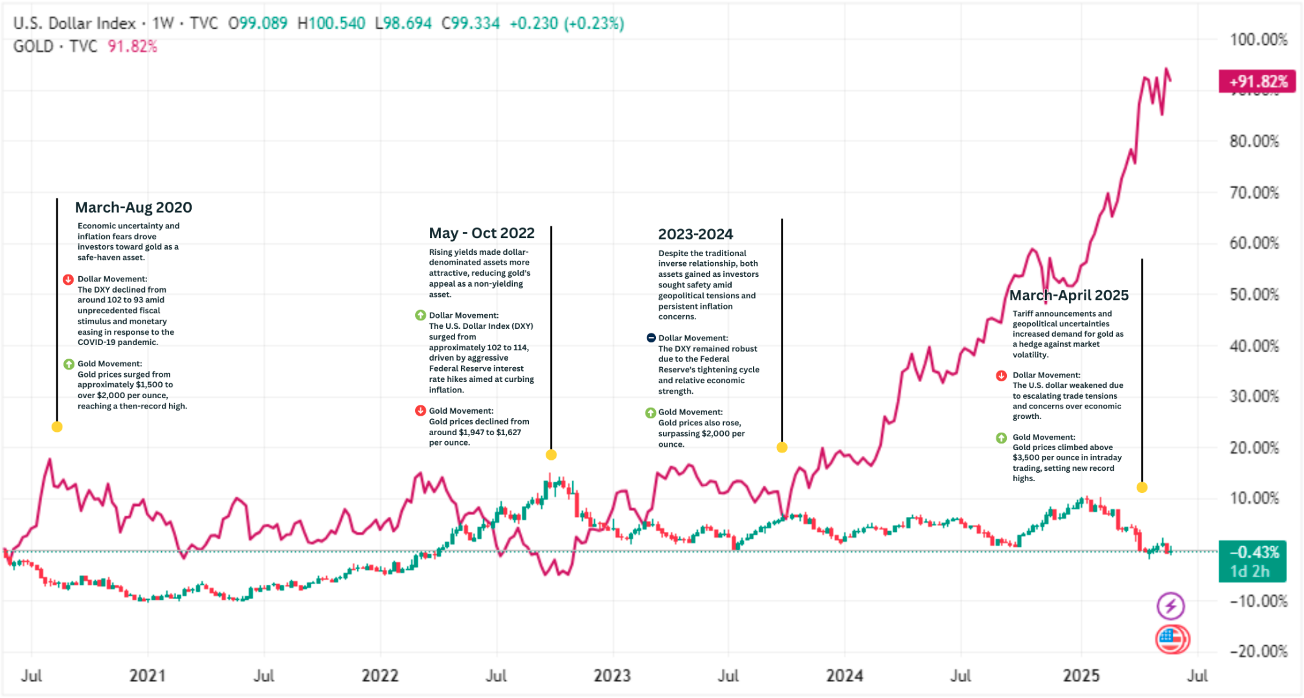
Figure 1: Relationship between gold prices and USD
The imposition of tariffs also impacts currency values, notably weakening the U.S. dollar. Analysis from the Centre for Economic Policy Research (CEPR) highlighted a significant depreciation in the dollar following the April tariff announcement due to foreign investor rebalancing of equity portfolios. A weaker dollar generally makes gold more attractive to international investors, further driving its price upward.
Central Bank and Institutional Demand
Central banks significantly increased gold acquisitions in response to geopolitical risks and economic uncertainty. JPMorgan noted that central banks purchased over 1,000 tonnes of gold in 2024, with continued robust buying into 2025. Such institutional demand underscores confidence in gold as a strategic reserve asset, providing fundamental support for sustained price increases.
Historical Context
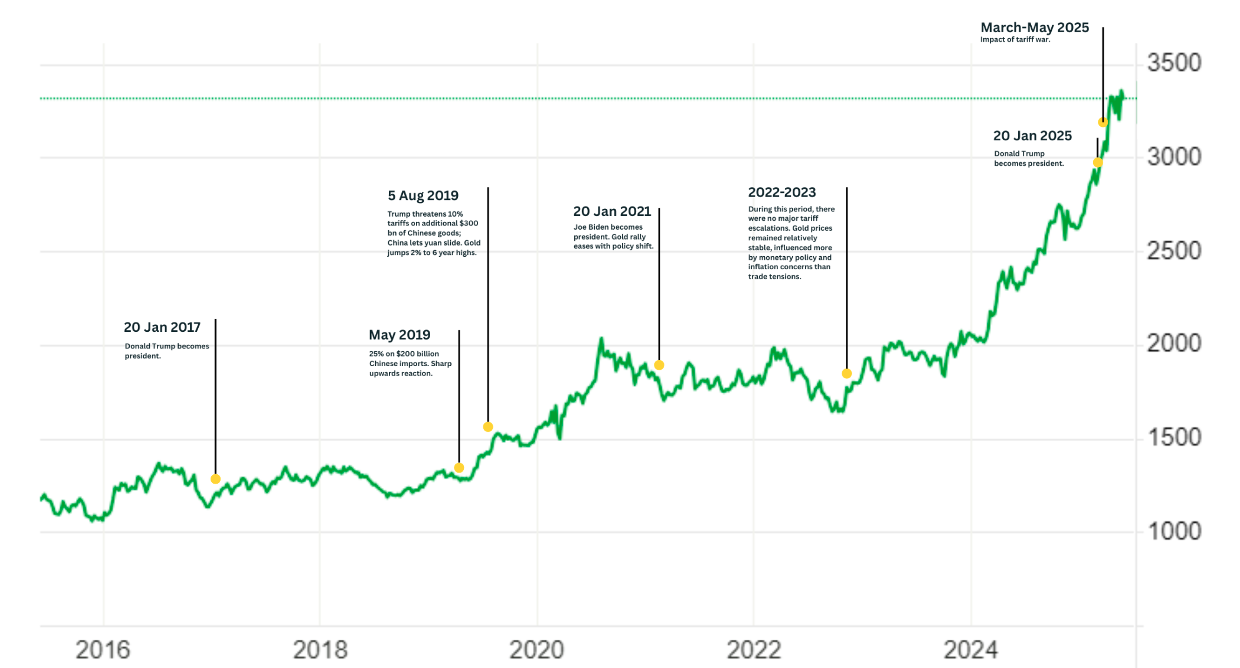
Figure 2: Impact of tariffs and policy changes on gold value
Reviewing historical precedent from Trump's earlier tariff actions reinforces current trends. In March 2018, when tariffs of 25% on steel and 10% on aluminium were introduced, gold pivoted upward, breaking from its stagnant range between $1,100 and $1,400 per ounce. Subsequent tariff escalations throughout Trump's first term repeatedly corresponded with notable gold price rallies.
Similarly, in the current scenario, gold prices escalated from $2,536.71 per ounce post-Trump’s re-election in November 2024 to record highs exceeding $3,357 by April 2025—a remarkable increase of nearly 32%. Physical market indicators also reflect this bullish sentiment; China's gold market premium soared to $39/oz on April 11, indicating robust physical demand despite elevated prices.
Market Observations
Detailed market data from the first months of 2025 confirms these dynamics. U.S. Treasury yields rose sharply, signalling increased inflation expectations, with the 10-year yield reaching 4.478% by April 11, marking one of the most substantial weekly jumps in decades. Physical gold markets saw increased premiums in Asia, with China's premium rising notably, underscoring the sustained global demand underpinning gold’s bullish trajectory.
Rate Forecasts
Prominent financial institutions have revised their gold forecasts significantly upward in response to Trump's trade policies:
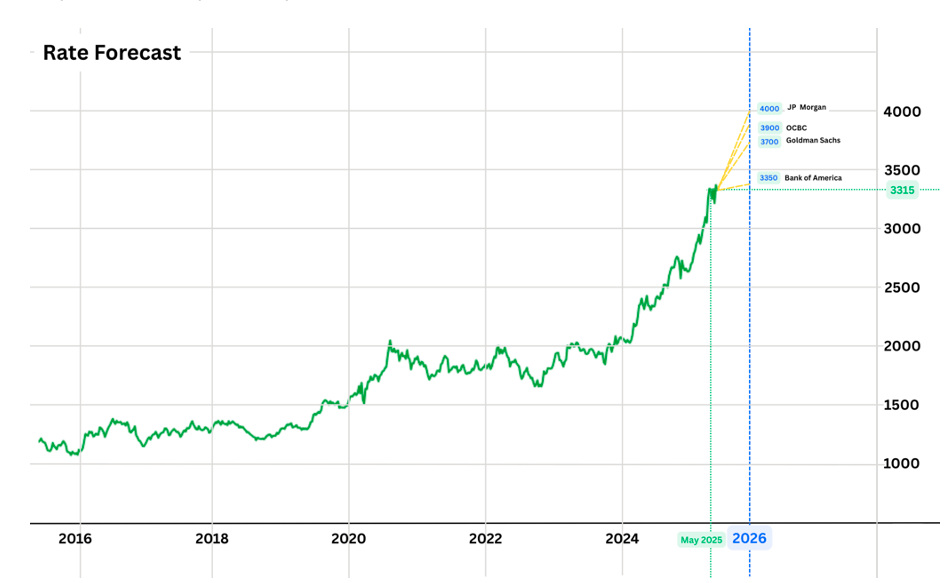
Figure 3: Forecasts for 2026
- Goldman Sachs projects gold prices reaching $3,700 per ounce by year-end 2025, emphasising continued central bank buying and robust investor inflows due to recession and inflation fears.
- Bank of America forecasts an average gold price of $3,063 in 2025, rising further to $3,350 in 2026, citing persistent trade-related uncertainties as key drivers.
- JPMorgan provides an even more bullish outlook, suggesting gold could average $3,675 by Q4 2025, potentially surpassing $4,000 by 2026 if central bank and investor demand remain elevated.
- OCBC Bank supports a bullish scenario, predicting gold could approach $3,900 within the next year due to escalating trade tensions and associated economic instability.
Potential Risks
While the outlook for gold remains bullish, investors should be mindful of potential mitigating factors. Notably, the Federal Reserve has maintained its benchmark interest rate at 4.25% to 4.5% as of May 2025, adopting a cautious approach amid economic uncertainties. The Fed's May meeting minutes highlighted concerns over persistent inflation and rising unemployment risks, suggesting a careful balance in policy decisions. Additionally, any easing of trade tensions or rollback of tariffs could reduce market uncertainties, potentially diminishing gold's appeal as a safe-haven asset. However, ongoing geopolitical risks and central bank gold purchases continue to provide support for gold prices.
Conclusion
President Trump’s 2025 tariff measures have clearly amplified gold's attractiveness by fueling inflation, economic uncertainty, and currency depreciation, all of which historically enhance gold’s value. The ongoing robust demand from central banks and institutional investors further supports continued appreciation. Although potential tariff rollbacks or monetary tightening may pose temporary setbacks, prevailing conditions strongly suggest sustained bullish momentum for gold prices. Investors seeking to hedge against ongoing trade tensions and macroeconomic instability will find gold particularly compelling in this environment.