
How to counter inflation in 2022?
How to counter Inflation in 2022?
It's no secret that inflation rates have been on the rise since the pandemic began. In order to combat this, investors need to be proactive in their investment strategies and be aware of which assets are likely to retain their value in times of inflation. In this article, we will explore some of the best ways to protect your investments against inflation in 2022.
Impact of Inflation
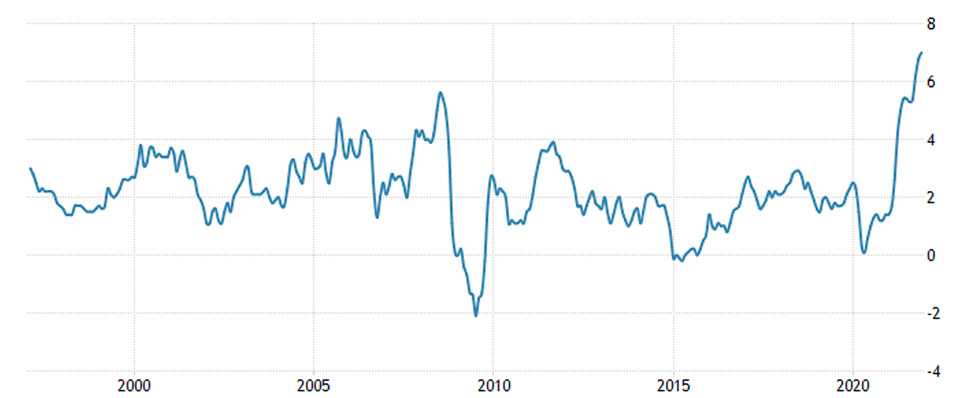
Fig 1 | Source: Trading Economics
Figure 1 shows that through the years, inflation has gone up and down. It went on a roller coaster in the 2008 financial crisis, stabilized a bit, and then climbed back again in 2020 due to the pandemic. It is likely to hit double digits due to rising fuel costs, political uncertainty, and a myriad of other reasons.
The real question is, how does inflation affect your money? It's best to know what you're dealing with before things go sour.

First of all, it's good to understand what inflation is. Simply put, it's when there is an increase in the available currency which causes the value of an individual dollar to decrease. If you went to buy bread at $1 today and next year it's $2 for the same amount of bread, that is considered inflation.
During times of inflation, keeping your money in a traditional savings account will yield less results as time goes on. In fact, if your money is in a regular savings account right now, it will be worthless 10 years from now.
For instance banks in the USA are currently paying an interest rate between 0.5% to 0.7% on savings. If you park $100,000 for a year you will have $100,500 at the end. Now if we adjust this for inflation which is currently at 7% then the real purchasing power of $100,500 will be equal to $93500.
At 7%, the inflation rate is just shy of double digits and going into hyperinflation. From an investors point of view, this is where alternative investment options should be used to counter inflation and bring some stability to your investment portfolio.
How to safeguard your savings?
The first rule of safeguarding your savings is to pull them out of the traditional bank account and put them in alternative investments where inflation has little effect. This can be done by diversifying your investment portfolio.
Portfolio Diversification

It is a general rule that risk-seeking investors have less diversified portfolios compared to risk-averse investors. Since the majority of investors are risk-averse, it makes sense to have a well-diversified investment portfolio.
Investors assemble their portfolio based on their risk appetite and time horizon but generally, a well-diversified portfolio should look like this:
1. Equity (40%-50%) - Types of equity depend on the risk appetite. There are a large number of options such as local and international stocks, ETFs, index and mutual funds etc
2. Bonds (20%-30%) - Government bonds provide stability, whereas corporate bonds provide higher returns.
3. Precious metals (10%-15%) - Gold, silver and other precious metals serve as a good hedge against inflation. Precious metal ETFs are also a good option.
4. Real estate (5%-10%) - Rentals, property flipping and REITs are some examples.
5. Other valuable assets (5%-10%) - You may want to invest in works of art and other such non-fungible tangible assets.
6. Money market products (5%-10%) - CDs and Cash provide much-needed liquidity to the portfolio. Their weightage should vary based on liquidity needed and protection required from inflation.
Let us now look at some alternative investment options that can help your investment portfolio counter inflation.
1) Gold bullion coins
Gold is traditionally seen as a safe haven against inflationary times. Historically, gold has been used as a store of value and hedge against inflation.
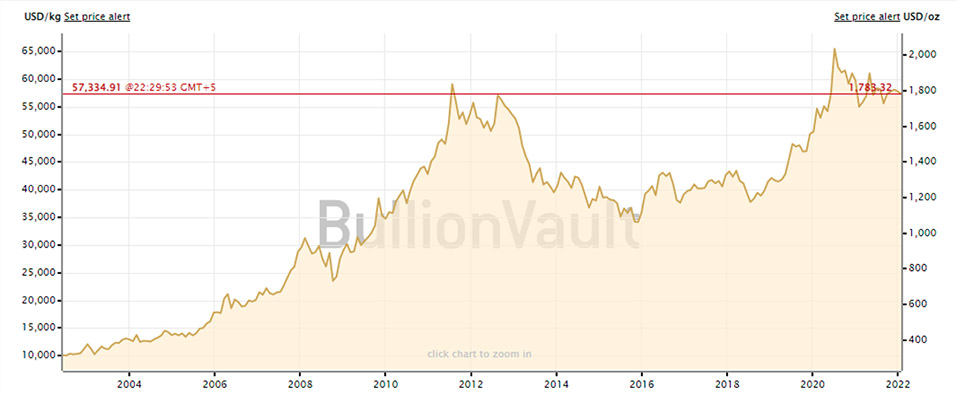
Fig 2 | Source: Bullion Vault

Figure 2 above shows that two decades ago, one ounce of gold was valued at $200 and today the same value of gold is valued at $1783. The annual return on gold touched 24.6% in 2020.
Gold bullion coins such as the American Buffalo, South African Krugerrand, or Canadian Maple Leaf are backed by governments and central banks. They offer the benefit of being an asset that doesn't depend on the fortunes of a particular company.
Bullion coins can be a solid way to not only counter inflation but also invest in an asset class that leads to capital appreciation and portfolio diversification.
2) Mining Companies
If you do not want to invest in just gold, you can always look at the bottom of the market and buy stocks of mining companies. Based on current market trends, this is a good time to not just hedge on gold but also on lithium and hydrogen stocks as these two elements are driving the sustainability and clean energy revolution.
A lot of investment is being pumped into the clean energy sector which is driving up lithium and hydrogen stocks. Lithium is a key metal in solar panels and batteries whereas Hydrogen is an alternative fuel set to replace fossil fuels.
3) Precious metals ETFs
Precious metal ETFs are similar to equities but are backed by physical gold, lithium, copper or any other underlying metal. These ETFs are traded on exchanges and follow the market closely.
Precious metal ETF showed a return of almost 9.5% last year. Although this is lower than the average return of the market it is more stable and it not only beats the rate of inflation but also provides stability to the portfolio as compared to volatile tech stocks.
The benefit of precious metals ETFs is that they allow you to invest and reap the benefits of the value of gold without actually buying the physical asset. The drawback is that in order to invest in an ETF, you will need a broker account and experience in investing in equities or an investment advisor to help you identify the best performing ETFs.
While investing in gold ETFs makes sense. It is also a very good time to invest in copper and lithium ETFs because the ongoing green energy revolution is seeing a lot of investment pump into lithium and copper which are key metals that are driving the sustainability movement.
Investor Takeaway
Inflation can have a significant impact on the savings of an individual. Investments should be diversified to protect against inflation and ensure that your money is growing in value, not shrinking. If you're looking for some new investment opportunities, we suggest exploring alternative investments such as precious metals, real estate, hydrogen, and even CBD stocks.
Why take chances with traditional stocks when there are so many other options?