
How AI is reshaping energy demand
How AI is reshaping energy demand
The grid can't keep up. The opportunity is just beginning.

Every major technology wave has reshaped energy demand. Coal powered the Industrial Revolution. Oil defined the twentieth century. Artificial intelligence is different, and for the first time, a software-driven technology is consuming electricity at a scale that strains the physical grid itself.
Global power demand is rising at its fastest pace in over a decade, with AI-driven data centres accounting for nearly one-fifth of that growth. By 2028, their power consumption is projected to increase by 126 gigawatts annually, roughly equivalent to adding Canada's entire electricity demand to the global grid every year.
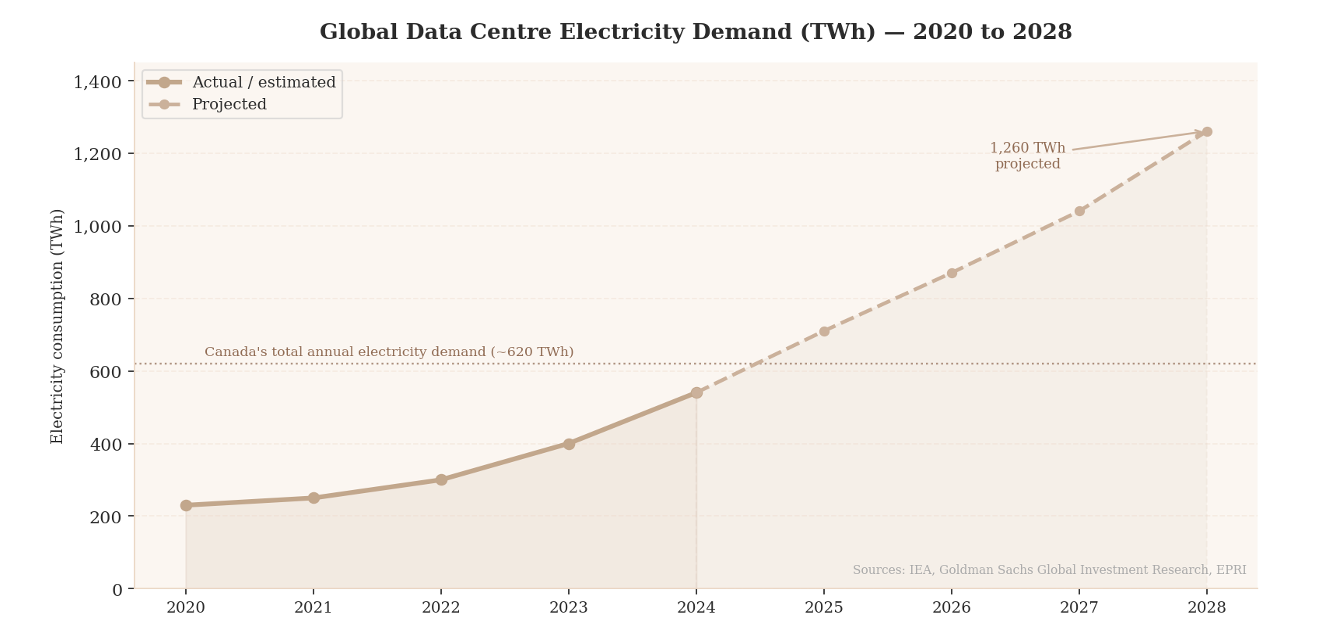
Global data centre electricity demand in TWh, 2020–2028. Sources: IEA, Goldman Sachs Global Investment Research, EPRI
Not all electricity is the same
AI workloads require continuous, uninterruptible power, a standard that many local grids were not planned for, given the speed and concentration of this new load growth.
The mismatch is pushing operators toward off-grid and behind-the-meter solutions, bypassing congested grid infrastructure entirely. Years of underinvestment have made the problem acute: power shortages are widely expected in 2027 and 2028 as data centre demand outpaces committed supply.
"As the world gets digitized and electrified by AI, it will require electricity of a certain type that a one-size-fits-all grid cannot deliver. If AI creates a $10 trillion GDP improvement through productivity gains, no one has really contemplated how much additional power all those users are going to need. It's mind-boggling."
— CEO, on-site electricity generation company, Morgan Stanley Thematic Conference, December 2025
Which sectors stand to benefit
Natural gas leads in the near term, dispatchable, reliable, and already scaling through spot and behind-the-meter contracts.
Nuclear holds the strongest long-term position. Microsoft's restart of Three Mile Island and Big Tech's growing interest in small modular reactors (SMRs) signal where patient capital is flowing. As Bill Gates wrote in How to Avoid a Climate Disaster: "It's the only carbon-free energy source that can reliably deliver power day and night, through every season, almost anywhere on earth, that has been proven to work on a large scale."
Grid infrastructure, transformers, transmission, and interconnection are a structural bottleneck with a long resolution timeline and improving regulated returns for operators who invest now.
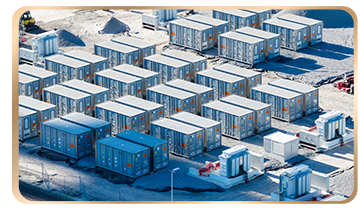
Battery storage and fuel cells are gaining ground as behind-the-meter solutions for load management and backup at data centre scale. Fuel cells are being evaluated for data-centre backup and load-management applications, though large-scale deployment remains early.
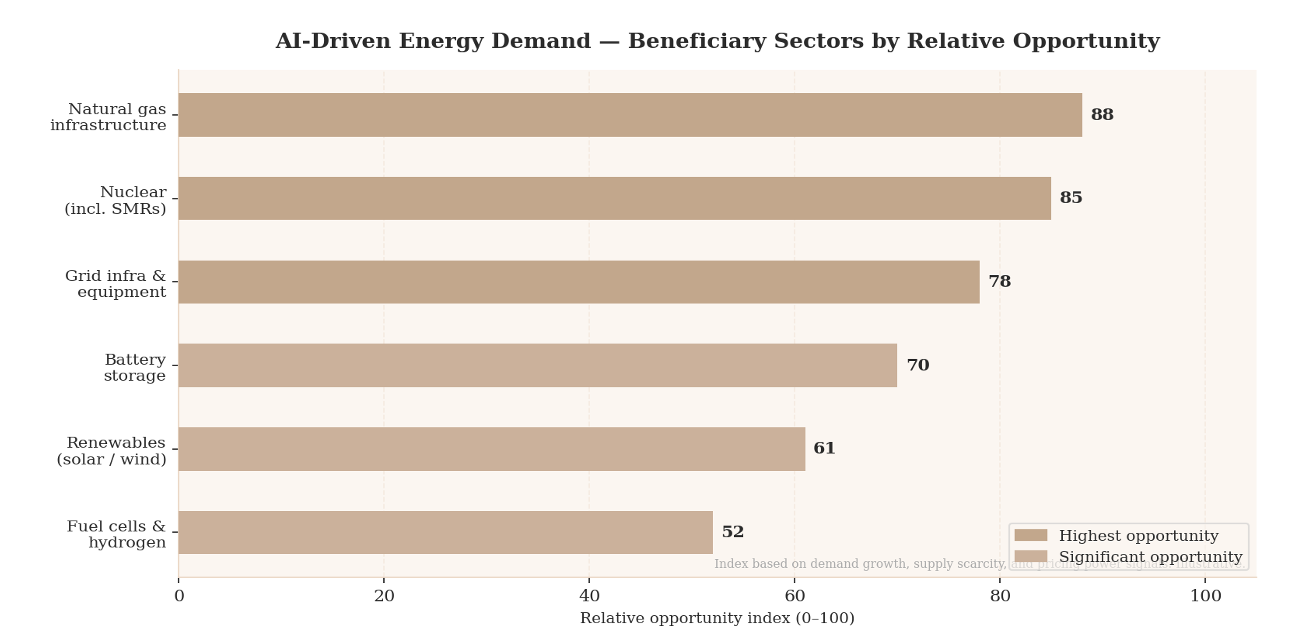
Relative opportunity index across energy sectors driven by AI demand. Illustrative scoring based on demand growth, supply scarcity, and pricing power signals
The long-term picture
What is underway is not a demand cycle. It is a structural transformation of the global power industry, one that will play out over multiple decades, driven by the compounding effect of AI adoption, electrification, and the productivity gains that follow. As one energy analyst framed it at a recent investor conference: the rest of the economy does not slow down while AI grows. It accelerates alongside it.
In some US and European markets, consumers are beginning to question whether data centre expansion is raising their electricity bills, creating regulatory pressure on grid-connected operators and a relative advantage for independent power producers with direct market pricing exposure.
Investor takeaway
- AI is driving structural, not cyclical, energy demand growth through 2030 and beyond.
- Power availability is emerging as a critical constraint for AI infrastructure. In some regions, delays in grid connections are already influencing where new data centres are built, while increasing the value of sites and assets with secured access to power.
- The clearest near-term sector beneficiaries are natural gas infrastructure and grid equipment. The clearest long-term beneficiary is nuclear, including SMRs.
- Independent power producers carry more direct upside than rate-regulated utilities in a sustained high-power-price environment.
- Distinguish between rate-regulated utilities, which offer constrained upside, and independent power producers, which carry direct exposure to rising spot power prices and stronger long-term pricing power.