
Explaining the exponential growth of renewable energy
Explaining the exponential growth of renewable energy
In the early 20th century, renewable energy was a fringe technology used only by a select few. But over the past few years, it has experienced exponential growth as the focus has shifted, technologies have improved and prices have fallen. In fact, renewables are now the fastest-growing source of electricity and power generation in the world. Here we will explore some of the factors driving this growth and examine how renewable energy is reshaping the investment landscape.

A look into the past.
The industrial revolution put the world on a fossil-fueled roller coaster ride. Over a century of fossil-fueled progress created the world as we know it today but at the cost of our climate. During this time period, renewable energy was not a major player and its costs were high and the technological prowess low.
As the population grew and economies blossomed so too did our need for electricity and fossil fuels became the workhorse of choice to meet those needs. Oil, natural gas and coal-fired power plants started dotting the landscape as renewable sources. Fossil stocks became a must-have in every investor's portfolio.
It was around the turn of the millennium that renewable energy sources started to become a part of our discourse. However, due to a lack of awareness and no visible evidence of global warming, renewables remained on the back burner.
This lack of attention pushed the renewable energy sector into a niche that was only deemed suitable for remote areas. This lack of interest and attention was also forced by the absolute supremacy of oil.
With fossil fuels being the main source of energy and profits for investors, no one was willing to give more attention to very obvious data that was spelling doom for the oil and gas industry. As a result, much-needed funding was kept away from the renewable energy sector, inhibiting any chances of growth.
This situation started to change around 2008. Around this time the clean energy and sustainability movement picked up pace due to the noticeable effects of global warming. People could now correlate data with melting ice caps and freak weather patterns across the world.
Increased traction of renewable energy in news, forums like WEF and Paris agreement lead to increased funding for solar, wind and hydropower projects. Increased funding logically started creating economies of scale, which is now leading to reduced cost and ingenious new ways of developing renewable energy equipment.
What is driving the growth of renewables?

The main driver behind the exponential growth of the renewable energy sector has been the Paris agreement. Prior to the agreement, renewables were gaining traction but that traction was simply not enough to attract investment that could help in scaling up renewable energy production across the world.
It took a drastic climate crisis for the leading economies to sit together and come to a consensus to initiate the transition to clean energy. This was a pivotal point because this consensus indicated to the investors that the leading economies have decided to funnel more money into the renewable sector and gradually phase out fossil fuels.
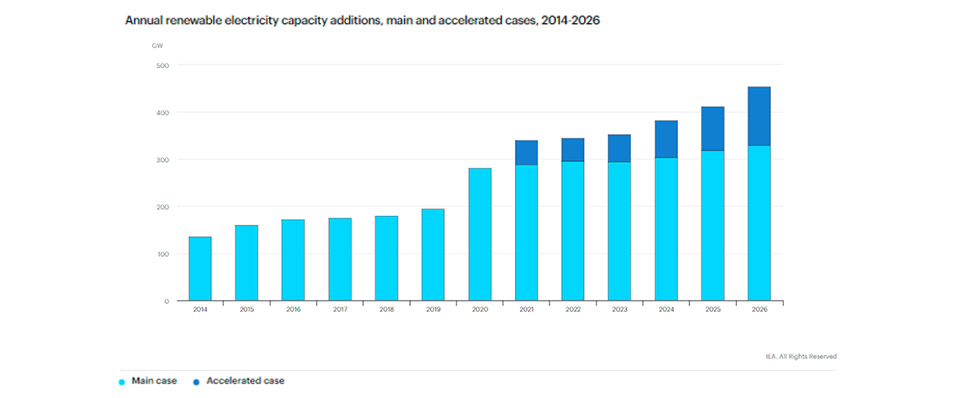
Figure 1: Source: IEA
Figure 1 shows how the Paris Agreement has catalyzed global renewable energy additions. It was signed in 2016 and we can see that with a lag of three years, the contribution of renewable energy sources started to increase significantly.
China is expected to be the biggest contributor to global renewable energy growth at 43%, followed by Europe, USA and India. Over the next 5 years, 80% of the global renewable energy expansion is expected to be concentrated in these four markets.
This is now going to be a long term pattern and In the next five years, renewable energy capacity is expected to increase by 60%. So renewable energy investors have a lot of potential to extract from this sector in the years to come.
This explains why renewable investment has been on an upswing as well as renewable equipment prices have been on a downswing, thanks to economies of scale and reduced need for R&D. All these factors have contributed significantly to the exponential growth.
Is this the end for fossil fuels?
Make no mistake, the oil and gas industry is not going anywhere soon. By 2050, the global demand for energy will rise by 50% of what it is today. Renewables at present can only cater for a fraction of our total energy demand and with the current rate of increase, there is no way that renewables can completely phase fossil fuels out by 2050.

Figure 2: Global energy consumption by source | Source: Our world in data
This however means that the market share of renewable energy production is going to gradually rise every year. As renewable energy technologies become more affordable, they are increasingly making gains in both emerging and developed economies. Renewable investment is at an all-time high.
The global renewable energy industry has been growing at a rapid pace since 2008. According to IEA coal-powered almost 39% of the world in 2015 and renewable sources powered around 23% of the world. Six years later in 2021, the share of renewables grew up to 28%.
Investor Takeaway
In order to transition from fossil fuels, the Paris agreement needs to be followed by more countries. For now, it is a step in the right direction and one of the main reasons behind renewable energy's exponential growth. The rise of renewables has been so rapid that experts are predicting they will account for over half of total electricity generation within just a few decades - meaning we’ve seen renewable power capacity more than double since 2010! This is because people have become aware of its benefits and started investing heavily in solar panels and wind turbines as their use becomes cheaper than ever before. So where does this leave us? Well, with an opportunity to invest in clean energy sources that will help stop climate change while providing you with steady returns on your investment.